EN
What Makes an Excellent Industrial Fire Truck? Inside the Performance and Suppression Technology That Matters
What Makes an Excellent Industrial Fire Truck? Inside the Performance and Suppression Technology That Matters
Sep 24, 2026
A fire in a chemical plant, a tank farm, or a highway tunnel rarely behaves like an ordinary structure fire. Storage tank fires can burn for hours across an area too large for a single hoseline, spread as burning liquid rather than staying contained, and reignite even after a crew believes the fire is out (Nwabueze, 2016). Tunnel and large-span industrial fires bring their own problem: limited access, and often no safe way for crews to work close to the seat of the fire at all.
What actually determines whether an industrial fire truck is good at its job comes down to two things: whether its suppression system can handle a fire that behaves this unpredictably, and whether it can apply that suppression from wherever the crew can safely stand. Our Triple-Phase Jet Fire Truck is built specifically around those two questions, and this article uses it to walk through what that actually looks like in practice.
Why Industrial Fires Demand a Different Kind of Response
Petrochemical and tank farm fires present hazards that a standard structure fire does not, starting with the fuel itself. Most structure fires involve solid combustibles — wood, furnishings, building materials — that burn in place and can generally be knocked down with water alone. Petrochemical facilities instead deal primarily with hydrocarbons and other flammable liquids, a Class B fire hazard where water on its own is largely ineffective and can even spread burning fuel rather than extinguish it; controlling a fire like this typically requires foam and dry chemical working together rather than either agent alone.
That difference in fuel type is compounded by three further challenges. A storage tank fire can involve a burning surface far larger than any single monitor stream is designed to cover, and full-surface fires on larger tanks are explicitly flagged in industry fire-safety literature as a scenario monitor nozzles alone are not considered adequate to handle (Nwabueze, 2016). Where an explosion precedes the fire, as it often does at these facilities, any fixed suppression system on site can be damaged in the same event, leaving mobile equipment as the only remaining option (Nwabueze, 2016).
Reignition is a separate and persistent problem. A foam blanket can be broken down by wind or continued radiant heat well before the underlying fuel has cooled, and once it fails, a hydrocarbon fire is well known for reigniting. Tunnels and long-span industrial buildings add a fourth complication: heat and smoke are trapped rather than dispersed, and crews often cannot get close enough to apply agent by hand at all.
Taken together, fuel type, scale, reignition risk, and confined or hard-to-reach spaces make up the four-fold challenge that sets petrochemical and industrial fires apart from an ordinary structure fire. Meeting it calls for a fire truck that carries the right combination of suppression agents rather than water alone, and that can put a large volume of agent onto a fire from a genuine distance or height. That is the starting point for evaluating what QingLing Isuzu Motors built into the Triple-Phase Jet Fire Truck.
Suppression Chemistry: Why One Agent Is Rarely Enough
Each conventional agent has a well-known weak point. Water cools a fire but does little to stop burning hydrocarbons from spreading further. Foam forms a blanket that isolates fuel from oxygen, but that blanket can be broken down by wind or sustained radiant heat, and industry guidance specifically flags foam quality and continuity as a common point of failure in large tank fires (Nwabueze, 2016). Dry chemical knocks a flame down almost instantly but does very little cooling, so without a way to manage the heat underneath it, the fire it just extinguished can flare back up within moments.
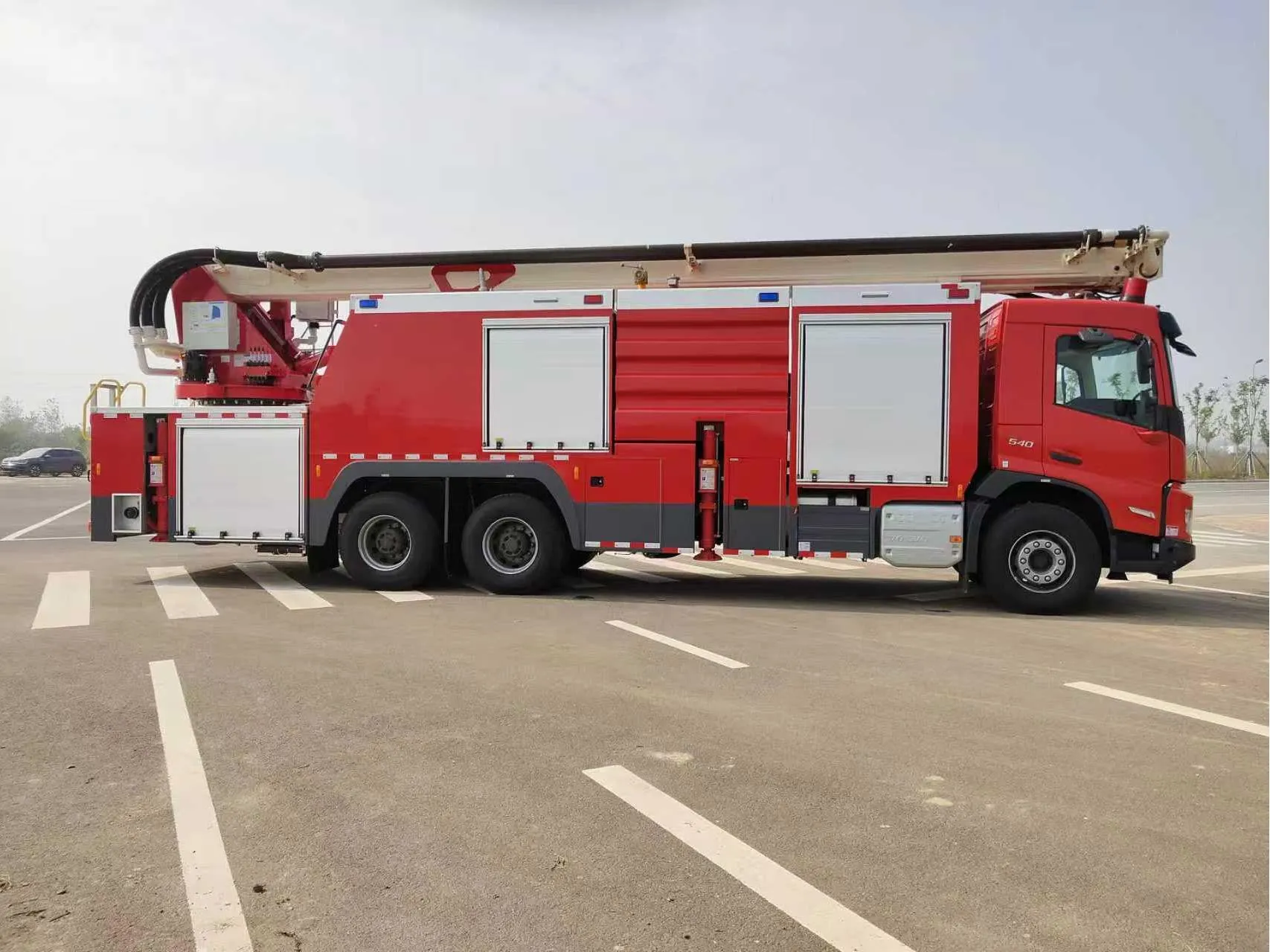
The Triple-Phase Jet Fire Truck addresses this by combining three agents rather than relying on one. High-pressure nitrogen, the gas phase, helps starve the fire of oxygen at the point of application. Water or a pre-mixed anti-reignition agent, the liquid phase, cools the fuel and surrounding surfaces. Ultra-fine dry powder, the solid phase, interrupts the chemical chain reaction that sustains a flame, giving very fast knockdown. Used together, the manufacturer describes the combination as working through four mechanisms: free-radical suppression, rapid cooling, emulsification and isolation of the fuel surface, and oxygen displacement.
The practical effect is a suppression system with fewer single points of failure. If wind or continued heat degrades the cooling effect, the oxygen-displacement and chain-reaction-interruption mechanisms are still working at the same time, rather than the crew depending on one agent to do the entire job. For a pool fire or a tank fire, where reignition after apparent knockdown is one of the more common ways an incident escalates again, that built-in redundancy is the main advantage.
Reach and Scale: Matching Power to the Size of the Hazard
Getting agent onto a fire is only useful if the vehicle can do it from where its crew can safely stand. Radiant heat from a large petrochemical fire is not a minor inconvenience: exposure of around 5 kW/m² is enough to cause second-degree burns within 60 seconds, and exposure above roughly 10 kW/m² can be fatal within the same window (Nwabueze, 2016).
This is why the Triple-Phase Jet Fire Truck is built around a telescoping tower rather than a fixed monitor position. Depending on configuration, it reaches a maximum working height of 18, 28, or 42 metres, with a working radius of 8 to 20 metres, letting the boom apply agent from above a tank’s rim or across the gap separating a crew from an unstable structure. Once in position, the system delivers water at up to 170 litres per second through the fire pump, with the monitor discharging up to 100 litres per second and reaching 75 to 85 metres depending on which phase is in use. Onboard agent capacity ranges from 7,600 to 15,000 litres across the three configurations.
Built for the Sites That Need It Most
This Triple-Phase Jet Fire Truck specializes in petrochemical and coal chemical facilities, natural gas installations, chemical production plants, and tunnel fire rescue, as well as ground-level hazards such as flowing fuel fires and pool fires. Each of these settings draws on a different combination of the performance points above.
At a tank farm or petrochemical site, the priority is usually height and reach: a tower configuration lets the crew apply agent down into an open tank or across a rim-seal fire from a position the radiant heat of a full-surface fire would otherwise put out of reach. In a chemical production plant, where a fire may involve reactive or reignition-prone materials, the triple-phase combination matters more than the tower height, since the redundancy across three suppression mechanisms is what limits the chance of the fire coming back after apparent knockdown.
Tunnels present a more particular case. Working height matters less than the vehicle’s ability to apply a large volume of agent quickly into a confined space where crews cannot follow the fire in on foot, which is where the combination of high pump flow and a suppression system that does not depend entirely on a sustained foam blanket becomes useful.
In each case, the vehicle is not being asked to do one job. It is being matched to whichever combination of reach, agent redundancy, and flow rate the specific hazard calls for.
An industrial fire truck earns its place at a petrochemical site, a tank farm, or a tunnel portal on two questions: can its suppression system handle a fire that behaves unpredictably once conventional agents are applied, and can it apply that suppression from wherever the crew is actually able to stand. The Triple-Phase Jet Fire Truck is built around both, combining gas, liquid, and solid agents to reduce dependence on any single mechanism, and offering a working height matched to the scale of the hazard rather than a single fixed configuration.
Configuration details, including tower height, agent capacity, pump rating, and chassis drive layout, can be adjusted to match a facility’s specific risk profile and local regulations. Further detail on the Triple-Phase Jet Fire Truck is available through QingLing Isuzu Motors’ product page.
References
Nwabueze, D. O. (2016). Liquid hydrocarbons storage tank fires – How prepared is your facility? Chemical Engineering Transactions, 48, 301–306. https://doi.org/10.3303/CET1648051
Recent Posts

October 26, 2016
The Most Successful Engineering Contractor.webp?x-oss-process=image/resize,w_100/quality,q_100)
.webp?x-oss-process=image/resize,w_100/quality,q_100)
.webp?x-oss-process=image/resize,w_100/quality,q_100)

Contact US
Product Information
Quantity
Unit
Piece
Support order samples, customization, wholesale direct, and complete payment. If the product you look for does not have corresponding customized content, pls fill out the form below to contact us, and we will reply ASAP.