EN
What Parameters Should Be Compared When Purchasing an ARFF Vehicle?
What Parameters Should Be Compared When Purchasing an ARFF Vehicle?
Sep 16, 2026
Airport rescue and firefighting (ARFF) vehicles are essential equipment in an airport emergency response system. When an aircraft fire, emergency landing, or other sudden incident occurs, firefighting vehicles must reach the accident area in a very short time and quickly begin firefighting and rescue operations.
Therefore, when purchasing an ARFF vehicle, buyers should not compare only vehicle price, engine power, or exterior design. They should make a comprehensive assessment of firefighting capability, vehicle performance, response speed, safety, and long-term operating cost.
To facilitate side-by-side comparison, this article refers to AC 150/5220-10F, Guide Specification for Aircraft Rescue and Fire Fighting (ARFF) Vehicles, issued by the U.S. Federal Aviation Administration (FAA) in 2025. This document is an important reference for airports when preparing technical specifications for ARFF vehicle procurement. On that basis, this article groups the core comparison points into eight areas: firefighting-agent capacity, fire pump performance, firefighting turret performance, vehicle response speed, chassis and mobility, the HRET high-reach firefighting system, cab and firefighter safety, and after-sales service and lifecycle cost. The following sections explain, one by one, which parameters procurement teams should focus on.
1. Firefighting-Agent Capacity: First Confirm What Firefighting Capability the Vehicle Provides
Firefighting-agent configuration is one of the first parameters to consider when purchasing an ARFF vehicle, because the types and quantities of agents carried by the vehicle directly affect its ability to sustain firefighting and emergency response. Procurement teams should first determine which agents are required and what storage capacity is needed, based on the airport’s operational scale, main aircraft types, and applicable regulations and technical standards.
In a detailed comparison, four aspects can be assessed: agent types, storage capacity, agent delivery systems, and replenishment methods. For vehicles using water and foam systems, buyers should focus on water tank capacity, foam tank capacity, and the foam proportioning system. If the vehicle is equipped with a dry-chemical system, dry-chemical agent capacity and its delivery and discharge systems should also be compared. Procurement teams should also understand how agents are replenished and how efficiently that can be done, because after a firefighting mission the ability to refill quickly and return to readiness is an important issue in long-term airport operations.
It should be noted that more firefighting agent is not necessarily better. Larger tanks mean higher vehicle weight and may affect acceleration, braking, mobility, and fuel consumption. Therefore, buyers should not simply pursue larger agent capacity, but should strike a reasonable balance among firefighting needs, vehicle performance, and the airport’s actual operating conditions.
Key comparison points:
- Firefighting-agent types
- Water tank capacity
- Foam tank capacity
- Dry chemical agent capacity
- Foam proportioning system
- Firefighting-agent replenishment method and efficiency
2. Fire Pump: Compare Flow Rate and Pressure Together
The fire pump is one of the core systems that determine an ARFF vehicle’s firefighting capability. When comparing vehicles, buyers should not look only at “maximum flow rate,” but should also consider pump flow rate, working pressure, and continuous operating capability. For example, two systems may both be specified with a relatively high pump flow rate, yet actual discharge performance may differ if their working pressures are different. Buyers should also understand pump start-up time, priming capability, and whether the vehicle can perform Pump-and-Roll, that is, continue firefighting while the vehicle is moving.
Key comparison points:
- Maximum flow rate
- Working pressure
- Priming and start-up performance
- Continuous operating capability
- Pump-and-Roll capability (firefighting while moving)
3. Firefighting Turret: Focus on Range, Flow, and Control
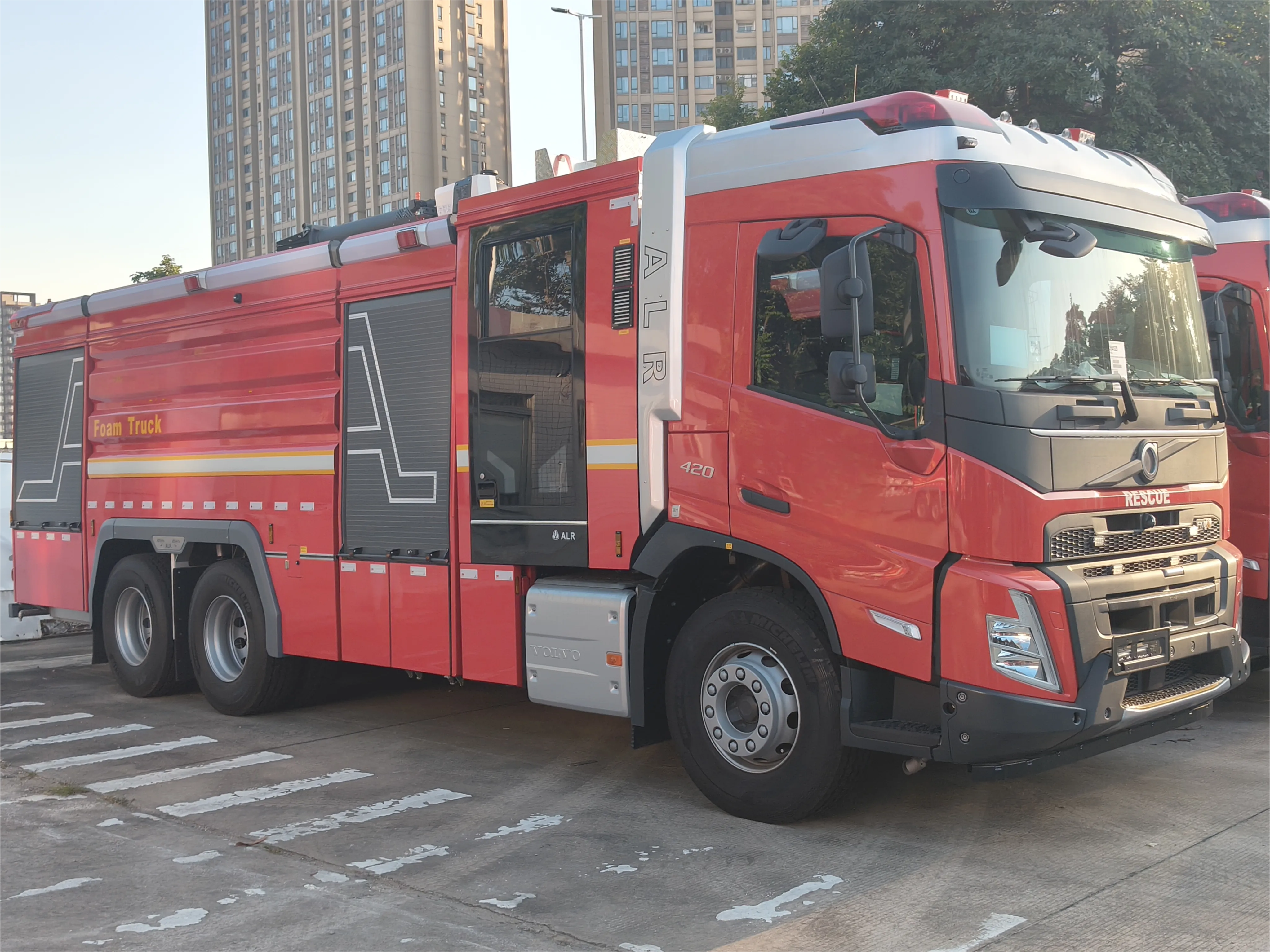
ARFF vehicles are typically equipped with firefighting turrets for rapidly covering an aircraft and its surrounding area from a distance. In procurement, buyers can focus on maximum flow rate, working pressure, effective range, water/foam discharge modes, horizontal rotation range, vertical elevation range, cab control methods, and camera and aiming-assistance systems. A meaningful comparison is not turret flow rate alone, but the combined performance of flow, pressure, range, and operating flexibility.
Key comparison points:
- Maximum flow rate
- Working pressure
- Effective range
- Water/foam discharge modes
- Horizontal rotation range
- Vertical elevation range
- Control method and aiming-assistance system
4. Vehicle Response Speed: Do Not Look Only at Maximum Speed
One of the core tasks of an ARFF vehicle is to reach the incident scene quickly. Therefore, acceleration and handling are equally important. In procurement, it is advisable to compare engine power and torque, full-load acceleration, maximum speed, automatic transmission performance, the braking system, steering performance, and stability under full load. ARFF vehicles are relatively heavy, but they still need reasonable acceleration and handling to shorten response time from the fire station to the incident area.
Key comparison points:
- Engine power and torque
- Full-load acceleration performance
- Maximum speed
- Automatic transmission performance
- Braking performance
- Steering performance
- Full-load stability
5. Chassis and Mobility: Adapt to Complex Airport Environments
Airports are not only smooth paved roads. Firefighting vehicles may need to travel across grass, unpaved areas, areas around runways, and other difficult surfaces, so chassis performance is also an important procurement indicator. Buyers should compare drivetrain configurations according to the airport’s actual environment and pay attention to mobility, stability, and controllability in complex conditions. For some airports, good mobility can help the vehicle approach the incident area more effectively.
Key comparison points:
- 4×4, 6×6, or other drivetrain configuration
- Maximum gradeability
- Minimum ground clearance
- Approach and departure angles
- Water-fording capability
- Differential locks
- Tire specifications
- Suspension system
- Turning radius
6. HRET High-Reach Firefighting System: Large Airports May Need to Consider It
For large airports or airports that must respond to incidents involving larger aircraft, a High Reach Extendable Turret (HRET) is also a configuration worth evaluating. HRET can position a firefighting turret at a higher point on the aircraft fuselage and, in certain cases, assist with fuselage-penetration firefighting. Procurement teams should therefore compare maximum working height, maximum reach, turret flow rate, extension-system stability, penetration capability, camera and thermal-imaging systems, and operating controls. Whether HRET is needed should be decided according to aircraft types, operational scale, and risk assessment, rather than simply pursuing a higher level of configuration.
Key comparison points:
- Maximum working height
- Maximum reach
- Turret flow rate
- Extension-system stability
- Penetration capability (where applicable)
- Camera and thermal-imaging systems
- Operating and control method
7. Cab and Firefighter Safety: Focus on the Emergency Operating Environment
ARFF vehicles operate in conditions that include high temperature, smoke, and high-speed response, so personnel safety should not be overlooked. In procurement, buyers can compare cab safety structure, seats and seat belts, the air-conditioning system, 360° camera systems, reversing assistance, thermal-imaging equipment, driver visibility, warning systems, and electrical-system protection. A good driving environment can help the driver operate the vehicle more quickly and accurately in an emergency, and can also improve firefighter safety during operations.
Key comparison points:
- Cab safety structure
- Seats and seat belts
- Air-conditioning system
- 360° camera system
- Reversing assistance
- Thermal-imaging equipment
- Driver visibility
- Warning systems
- Electrical-system protection
8. After-Sales Service and Lifecycle Cost: Do Not Compare Only the Initial Purchase Price
Finally, airports should not compare firefighting vehicles only by initial purchase price. An ARFF vehicle usually supports airport emergency operations over a long period, so buyers should also evaluate purchase price, transportation cost, maintenance cost, spare-parts supply, training, warranty service, and service life. This is especially important for overseas airport procurement projects. Whether local after-sales service is available, whether spare parts can be supplied reliably, and whether technicians can respond in time can all affect the vehicle’s long-term operating efficiency. Therefore, a supplier’s technical support and long-term service capability should also be part of the procurement evaluation.
Key comparison points:
- Purchase price
- Transportation cost
- Maintenance cost
- Spare-parts supply capability
- Technical training
- Warranty service
- After-sales response time
- Expected service life
Conclusion
Purchasing an airport firefighting vehicle is a comprehensive technical decision. What really deserves comparison is not any single parameter, but whether the vehicle’s firefighting capability, response speed, mobility, safety configuration, and long-term reliability match the airport’s actual needs.
Therefore, when preparing a procurement plan, airport management should first clarify its own operational scale, main aircraft types, airport roads and terrain, and emergency rescue requirements, and then determine the configuration of water tanks, foam tanks, fire pumps, firefighting turrets, chassis, and high-reach firefighting systems according to those needs. For ARFF vehicles, an appropriate configuration is more important than simply pursuing larger specifications. In addition, if you are also selecting an airport firefighting vehicle suitable for your project and have any questions about parameter selection, further consultation is available upon request. We look forward to the opportunity to collaborate with you.
References
Federal Aviation Administration. (2025, June 26). AC 150/5220-10F: Guide specification for aircraft rescue and fire fighting (ARFF) vehicles. U.S. Department of Transportation, Federal Aviation Administration. https://www.faa.gov/airports/resources/advisory_circulars/index.cfm/go/document.current/documentNumber/150_5220-10
Recent Posts

October 26, 2016
The Most Successful Engineering Contractor.webp?x-oss-process=image/resize,w_100/quality,q_100)
.webp?x-oss-process=image/resize,w_100/quality,q_100)
.webp?x-oss-process=image/resize,w_100/quality,q_100)


Mar 23, 2026
Why Can Fire Pickup Trucks Be Used for Forest Fires?Contact US
Product Information
Quantity
Unit
Piece
Support order samples, customization, wholesale direct, and complete payment. If the product you look for does not have corresponding customized content, pls fill out the form below to contact us, and we will reply ASAP.