EN
Why Can Fire Pickup Trucks Be Used for Forest Fires?
Why Can Fire Pickup Trucks Be Used for Forest Fires?
Mar 23, 2026
Combining rapid response, off-road mobility, and initial fire suppression capability, fire pickup trucks are becoming an important part of forest fire protection
Forest fires are characterized by sudden outbreak, rapid spread, and complex terrain conditions. Compared with urban fires, forest fires often occur in mountainous areas, woodland zones, hilly regions, and rural-forest border areas where road access is limited. This places higher demands on emergency vehicles in terms of mobility, accessibility, and early-stage firefighting capability.
Against this background, fire pickup trucks have gradually become an important type of vehicle in forest fire prevention and mountain emergency rescue, because of their strong passability, flexibility, and ability to carry basic firefighting equipment. They are especially suitable for early forest fire response, forest patrol, mountain rescue, and frontline equipment transport.

1. Strong off-road capability for forest and mountain roads
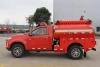
Firefighting pickup trucks are usually built on reinforced 4×4 pickup chassis, offering good stability and adaptability to different road conditions. Compared with larger conventional fire engines, they are more flexible when traveling on forest roads, mountain roads, rural access routes, and unpaved surfaces.
In forest fire scenarios, whether a vehicle can approach the fire point quickly is a key factor in effective early-stage control. In some forests, mountain areas, and locations with poor road conditions, large vehicles may face difficulties such as limited turning space, restricted passage, or inability to go deeper into the area. Firefighting pickup trucks, with their smaller size and stronger mobility, can often enter frontline zones more quickly.
This advantage makes them especially suitable for forest patrol roads, mountain fire prevention routes, and emergency operations in remote areas.
2. Fast response, ideal for controlling fires in the early stage
In forest fire prevention and control, the first few minutes are often critical. Many forest fires are still small at the beginning, but if they are not detected and handled quickly, they may spread rapidly under the influence of wind, vegetation, and weather conditions.
One major strength of firefighting pickup trucks is that they can serve as rapid response units. Their flexibility and quick deployment capability allow them to reach the scene promptly once smoke, open flames, or suspicious fire signs are detected, and begin initial response operations immediately.
For forest fires, early control is far more efficient than large-scale suppression at a later stage. Firefighting pickup trucks help frontline teams suppress fires before they expand, buying valuable time for larger professional firefighting forces to arrive.
3. Able to carry basic firefighting equipment for initial suppression
A firefighting pickup truck is not simply an ordinary pickup fitted with warning lights. It can be equipped with dedicated firefighting and rescue systems according to operational needs. In general, such vehicles can carry water tanks, fire pumps, hoses, nozzles, portable extinguishing tools, and other emergency rescue equipment.
This means that firefighting pickup trucks are able not only to patrol and assess the situation, but also to begin actual fire suppression work immediately after arriving on site. For small open flames, grass fires, forest-edge fires, and early surface fires, they can play an effective role in quick spraying and local containment, helping reduce the risk of further fire spread.
In a forest fire prevention system, this “arrive quickly and act immediately” capability has strong practical significance.

4. Useful carrying capacity for frontline support tasks
Forest fire response requires more than extinguishing equipment. Personnel, protective gear, communication devices, and emergency supplies also need to be transported to the frontline in time. Especially in remote forest and mountain areas, transport efficiency directly affects on-site operational capability.
Firefighting pickup trucks usually offer practical cargo space and can be used to transport firefighting tools, emergency lighting, personal protective equipment, communication devices, and basic supplies. For frontline forest patrol teams and emergency responders, a firefighting pickup truck is not only a fire suppression vehicle, but also an equipment transport and support vehicle.
In some forest areas where road conditions are limited, firefighting pickup trucks can complete frontline support tasks more efficiently. This is another important reason why they are increasingly valued in forest fire scenarios.
Why are firefighting pickup trucks especially suitable for early-stage control?
It should be noted that firefighting pickup trucks are not designed to replace large fire engines. For large-scale and continuously spreading forest fires, more systematic firefighting forces and professional equipment are still required.
The core value of firefighting pickup trucks lies mainly in the early control stage of a forest fire.
In other words, when a fire has just started, remains limited in size, and can still be handled quickly, these vehicles can use their flexible access, rapid response, and basic firefighting capability to reach the site early and begin control as soon as possible, helping prevent the fire from growing larger.
From the perspective of forest fire prevention, effective emergency management depends not only on how much large equipment is deployed later, but also on whether there is a fast and timely intervention in the early stage. Firefighting pickup trucks have a clear advantage in this part of the response chain.
Conclusion
Forest fire prevention and control require coordination across multiple stages, including early warning patrol, rapid response, initial suppression, and frontline support. Since forest environments often involve complex terrain, limited road access, and scattered fire points, relying only on large fire engines is often not enough to meet all operational needs.
With their strong mobility, adaptability to difficult road conditions, ability to carry basic firefighting equipment, and multifunctional support role, firefighting pickup trucks are playing an increasingly important role in forest fire prevention and response. They are especially valuable in forest patrol, mountain access, early-stage fire control, and frontline material transport.


Recent Posts

October 26, 2016
The Most Successful Engineering Contractor
.webp?x-oss-process=image/resize,w_100/quality,q_100)
.webp?x-oss-process=image/resize,w_100/quality,q_100)
.webp?x-oss-process=image/resize,w_100/quality,q_100)
Contact US
Product Information
Quantity
Unit
Piece
Support order samples, customization, wholesale direct, and complete payment. If the product you look for does not have corresponding customized content, pls fill out the form below to contact us, and we will reply ASAP.