EN
QingLing Isuzu Motors' Fire Command Vehicle: Pickup Agility Meets Full-Scale Firefighting Power
QingLing Isuzu Motors' Fire Command Vehicle: Pickup Agility Meets Full-Scale Firefighting Power
Aug 11, 2026
QingLing Isuzu Motors is expanding its firefighting vehicle lineup with the Fire Command Vehicle, an independently engineered, pickup-platform apparatus designed in-house to close the gap between an emergency call and the first jet of water. Built on a ISUZU 4×4 chassis and fitted with a fully integrated firefighting system, including an onboard pump, a fixed monitor, and a 1,500-liter water tank, the vehicle reflects the company’s own research and development rather than a stock conversion, and is designed for rapid emergency response, providing excellent maneuverability, faster deployment, and greater flexibility in accessing different locations.
The timing reflects where the industry is heading. The global fire truck market reached USD 8.7 billion in 2025 and is projected to grow to USD 16.9 billion by 2035 (Wadhwani & Ambekar, 2025). Within that growth, demand for smaller-capacity units has been rising as departments and enterprise brigades build fleets in which lighter vehicles handle much of the day-to-day rapid-response workload while larger apparatus are held for major structural incidents (Astute Analytica, 2025). The Fire Command Vehicle is built directly for that rapid-response role.
Engineering That Turns Compact Size Into a Firefighting Advantage
The vehicle is built on a QingLing chassis paired with an ISUZU powertrain: a 3.0-litre, 110 kW diesel engine meeting the Euro VI emissions standard, matched to an automatic transmission and 4×4 capability. The drivetrain is tuned for a fully loaded firefighting vehicle, providing a strong balance of performance and maneuverability while keeping the truck agile even with a full tank and crew aboard.
The compact wheelbase and excellent turning capability allow it to operate effectively in various environments, including village lanes, warehouse aisles, parking structures, and construction sites with tight turnarounds. Because the vehicle needs only a two-person crew, brigades can dispatch it immediately rather than waiting to assemble a full-strength engine crew. The result is a vehicle that can arrive during the early stages of a fire, when rapid suppression with a handline or monitor is most effective.
Fast deployment is the first step in emergency response, but effective firefighting capability is what makes a vehicle truly valuable on scene. The Fire Command Vehicle carries a complete, self-sufficient suppression system rather than simple transport and tools. A centrifugal fire pump, available with both imported and domestic options, built with a corrosion-resistant aluminum alloy body and impeller and a stainless-steel shaft, delivers a rated flow of 20 liters per second at 1.0 MPa, primed by an electric piston vacuum system so the crew is not relying on manual priming under pressure.
That output feeds a fixed monitor capable of full 360-degree rotation and an elevation range of at least -35° to +70°, throwing a stream at least 52 meters, far enough to attack a fire from a safe standoff distance without deploying a hoseline first. Behind both sits a 1,500-liter tank built from electrophoretically coated steel for long-term corrosion protection, sized to sustain an initial attack for several minutes before a hydrant or tanker arrives, or to fully extinguish smaller fires with no external water source at all.
At roughly 396 gallons, the tank places the vehicle solidly in the below-1,000-gallon class that industry trackers now track as a segment in its own right (Wadhwani & Ambekar, 2025), precisely because that range behaves differently in the field, prioritizing reach and readiness over total volume.
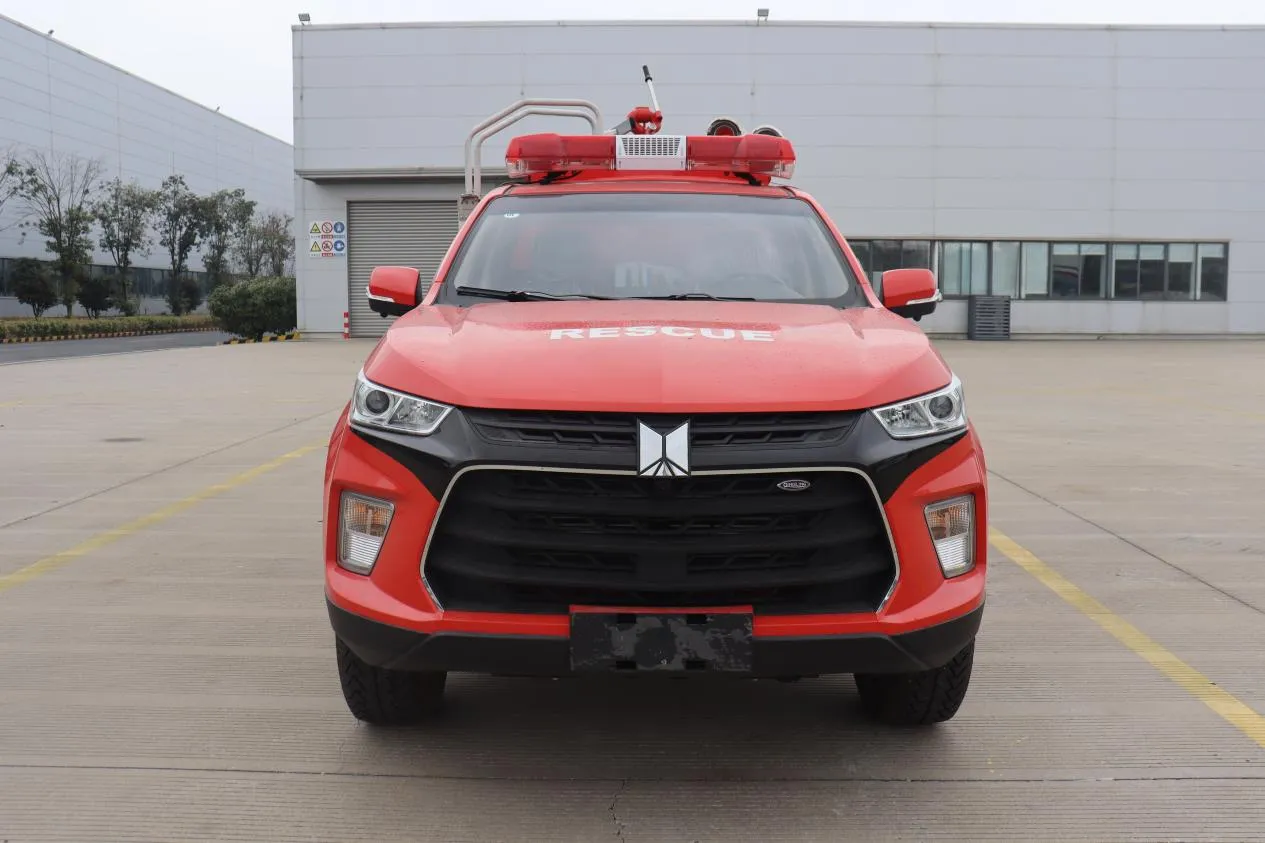
Multiple discharge outlets serve hoselines directly from the pump, while dedicated filling connections on both sides of the tank allow refilling from a hydrant or tanker, and a dedicated high-capacity water inlet line feeds tank water to the pump, so the truck can just as easily serve as a relay or refill point once backup arrives. These figures are not headline numbers for their own sake; together they give a two-person crew what it needs to turn “first on scene” into “fire under control” before a fire spreads.
The remaining advantage is procedural rather than mechanical: the vehicle is built to be operated safely by crews who may not have years of specialized training. Cab-mounted controls handle the warning lights, siren, and roller-shutter alerts, while a separate pump-room panel gives the operator direct control over engine start-stop, throttle, priming, and every discharge line, alongside live readouts for pressure, water level, engine speed, and temperature.
Low-liquid and overpressure protection engage automatically, reducing the risk of pump damage during a chaotic response. A 360-degree camera system with four parking sensors and a 7-inch, 1080p display supports maneuvering in the same tight spaces the chassis is built to reach, which matters as much on an unlit industrial road at night as it does in daylight.
Even the charging arrangement reflects this attention to readiness: a 220V shore connection keeps the battery topped up while the vehicle is on standby and automatically disconnects the moment the engine starts, so no one has to remember to unplug it before rolling out. Individually, these are small details. Together, they lower the training and staffing burden for the mini fire stations, enterprise brigades, and volunteer teams that make up much of this vehicle’s market.
From Rural Roads to Industrial Parks: Where the Fire Command Vehicle Delivers Value
QingLing Isuzu Motors designed the Fire Command Vehicle around a specific role in fire protection: sites that carry real fire risk and are well served by a compact vehicle that can be stationed close at hand and moved along constrained access routes. That includes mini fire stations, rural and township brigades, community and street-level protection units, parking facilities, and the full-time fire teams that enterprises and institutions are increasingly required to maintain on site. In each of these settings, the vehicle is built for a fire’s first few minutes, when a quick, self-contained response can help keep a small fire from developing into a structural one. Where a brigade can put water on a fire within that window, an incident can often be contained before additional apparatus is required.
That need is especially clear across the Middle East and North Africa, where fire services cover industrial sites, oil and gas facilities, and fast-growing cities across enormous, often sparsely served distances. Regional fleet investment is accelerating on the back of programs such as Saudi Arabia’s Vision 2030, which is directing substantial spending into fire safety and infrastructure across urban, industrial, and transportation projects (Wadhwani & Ambekar, 2025).
At the same time, operators across the region consistently prioritize durability and reliability in vehicles built to withstand extreme heat and harsh, uneven ground (Wadhwani & Ambekar, 2025). A compact, self-sufficient unit that can be stationed directly at a remote facility, rather than dispatched from a distant central station, addresses both pressures at once: it is easier to position across a large industrial footprint and easier to keep operational in demanding conditions.
In Southeast Asia, growth is tracking industrial and urban expansion. Asia Pacific is forecast to grow faster than any other region through 2035, at a compound annual rate of 8.8%, with airport and industrial development among the strongest demand drivers as governments push emergency-response capability toward international standards (Wadhwani & Ambekar, 2025). For the industrial parks, logistics hubs, and expanding township communities common across the region, the Fire Command Vehicle’s narrow footprint and tight turning radius are practical advantages on roads and internal estate lanes where access is often constrained, while its dual-panel control layout suits enterprises that are building in-house fire response capability for the first time.
Latin America presents a related but distinct case. Much of the region relies heavily on imported apparatus, since many countries lack a large domestic fire truck manufacturing base (Wadhwani & Ambekar, 2025), and that reliance is intensifying as wildfire risk grows. Colombia, Guatemala, Costa Rica, and Honduras have all reported significant wildfire activity in 2026, with forecasters warning that a potential “Super El Niño” could intensify fire conditions across the region through 2027 (Riskline, 2026). For rural brigades and municipalities facing that risk on limited budgets and difficult terrain, a rugged 4×4 platform that can reach remote roads offers a practical way to extend first-response coverage beyond a single central station.
What ties these markets together is not geography but a shared operating requirement: the ability to begin firefighting quickly at sites where access is constrained or the distance from the nearest station is long. The Fire Command Vehicle is built for that requirement, pairing a chassis designed for access with a pump, monitor, and tank capable of a genuine independent attack. Chassis and upper-body construction are engineered to meet applicable national vehicle and fire-apparatus standards, and configurations, including tank capacity, pump specification, and onboard equipment, can be adjusted to match local regulations, climate, and operating procedures. For fire departments, enterprise brigades, and municipalities assessing how to close first-response gaps without expanding fleet size or budget, the Fire Command Vehicle is available for inspection and configuration through QingLing Isuzu Motors’ product page (https://www.firefightingtruck.com/).
References
Astute Analytica. (2025, December 16). Fire truck market: Industry dynamics, opportunity analysis and forecast for 2026–2035. https://www.astuteanalytica.com/industry-report/fire-truck-market
QingLing Isuzu Motors. (n.d.). Fire command vehicle. Firefighting Truck. https://www.firefightingtruck.com/shop/fire-command-vehicle-1
Riskline. (2026, July 13). Wildfires 2026 and travel disruptions. https://riskline.com/informer_reports/wildfires-2026-travel/
Wadhwani, P., & Ambekar, A. (2025, December). Fire truck market size & share, 2026–2035. Global Market Insights. https://www.gminsights.com/industry-analysis/fire-truck-market

.webp?x-oss-process=image/resize,w_100/quality,q_100)
Recent Posts

(1).webp?x-oss-process=image/resize,w_100/quality,q_100)
.webp?x-oss-process=image/resize,w_100/quality,q_100)
.webp?x-oss-process=image/resize,w_100/quality,q_100)
Contact US
Product Information
Quantity
Unit
Piece
Support order samples, customization, wholesale direct, and complete payment. If the product you look for does not have corresponding customized content, pls fill out the form below to contact us, and we will reply ASAP.